Tuesday, July 30, 2019

What Does Sustainable Mean to You?

During a recent conversation, I was asked one of the most complex questions I have ever been asked: what does sustainable mean to you?

I wasn't expecting the question and was caught off guard.  However, since I was attempting to impress the one who asked, I thought quickly and came up with what I thought was a decent answer.  At a pasture walk I had attended earlier in the month, a speaker had been talking about grazing systems and had spoken about regenerating the land and ecosystem to the point that it is sustainable and doesn't need outside help.  I talked about that and the person who had asked the question seemed to like my answer and the conversation moved on.

The question, however, stuck with me.  I've been pondering it these past couple of weeks, somehow not fully satisfied with my answer.  Part of the problem is that I used the word "sustainable" in my answer.  That's just embarrassing.  Another part of the problem is that "sustainable" is ridiculously difficult to define due to the complexity of the systems to which the term is generally applied.

For example, let's say I want my farm to be sustainable.  In what way do I want it to be sustainable?  I could say I want it to be financially sustainable so that I don't have to work off the farm.  But that might destroy the environment or break down relationships.  If I want to be environmentally sustainable, I might not be able to make money and the farm will fail.  If I desire relational sustainability, the farm might never grow or be profitable because I am trying to please everyone.  In every case, the farm breaks down.

So, for the farm to be truly sustainable, it must be able to sustain the integral relationships, the environment, profitability, and in all likelihood, a number of other factors, too.  I still haven't really defined "sustainable," though.  All I've done is illustrate it's complexity.

Back to the original question, then: what does sustainability mean to you?  As I said, I've been pondering that question for a couple of weeks now and have begun to form a fuller answer.  I still think that for a system to be sustainable, it should be able to exist without outside inputs.  For example, a farm is not truly sustainable if it requires the owner to have an off-farm job for extra income.  

But more than just existing as it is, I think sustainability means adaptability.  No system exists in a bubble.  The reality is that outside influences can and do easily disrupt the normal existence of a system.  Think about the effects of fires and floods on ecosystems, for example.  For a system to truly be sustainable, it must be able to adapt to changes, whether those changes come from within the system or from outside influences.

I have areas of pasture that flooded this year.  Those areas aren't going to be completely ruined, though, because the soil and ecosystem of the pasture is adaptable.  It is certainly not a fun scenario to deal with, but I know that the pasture will bounce back once the massive puddles dry up.  My bit of pasture is adaptable, and is, therefore, sustainable.  In a different situation, the flooding might devastate an area if the topsoil is thin and easily stripped away, and there is no diversity in the ecosystem to bring the land back to a healthy state.  That portion of land is not adaptable, and therefore, not sustainable.

This does not, of course, apply to any situation in which the change is catastrophic.  For example, I'm not about to call a town destroyed by a catastrophic flood unsustainable if it can't rebuild without help.  That would be ridiculous.

The approach of one of the storms that filled the low spots in my pasture with water. 
I've lost count of the number of times I've filled my boots out there.

I also want to point out that change can be good.  I might change my grazing system for the better, but the pasture is still going to need to adapt to that.  Through the adaptation process, the pasture might even be improved from what it was, so that it will be able to adapt even better the next time I change something.  I am not saying that change is good or bad.  However, it can cause stress on a system and that system must be able to adapt or it will not survive.

This has been a lot of words and explanation.  Allow me now to put my current definition into one sentence.  For a farm (or other system) to be sustainable, it must exist at a point at which it is able to adapt to change without outside aid.  

Edit: August 4, 2019
Since publishing this post, my definition has been slightly revised, thanks to responses.  My current working definition of "sustainable" is as follows: For a farm (or other system to be sustainable, it must continuously and actively maintain a balance of all parts,while being able to adapt to change without outside aid.

I might revise that definition many times throughout my life as I continue to read and learn and experience, but for now, you have my answer to our starting question.  Now, I will turn the question to you, my readers.  What does sustainable mean to you?

Send me your answers in the comments!  I look forward to learning from each of you!

Tuesday, July 16, 2019

Why I Took a Day Off to Walk Through a Pasture

I took a day off earlier this month.  The weather wasn't looking great and I didn't have too much on my to do list, so I got up far earlier than I normally would on a lazy Saturday and took off for parts unknown!

Actually, I drove for about 25 minutes along roads I've traveled many times and soon arrived at a pasture.  There were already several other vehicles parked on the hill, and people were standing around chatting and waiting for the coffee to arrive.  I had come to a pasture walk.

This pasture walk was put on by the Gateway Research Organization (GRO) and Greener Pastures Ranching and was held in a pasture managed Steve Kenyon from Greener Pastures.

For those of you who are unfamiliar with a pasture walk, allow me to explain what happens.  We walk.  Through a pasture.  We also listen to people talk about what they are doing, ask several dozen questions and generally have a great time.

At this particular pasture walk, we had two main speakers: Steve Kenyon and Brent Thygesen from Ducks Unlimited Canada.  These two men, along with Steve's wife, Amber (who works for GRO), showed us around a few different pastures and talked to us about a variety of topics, including, but not limited to the following:
  • the basics of good grazing practices
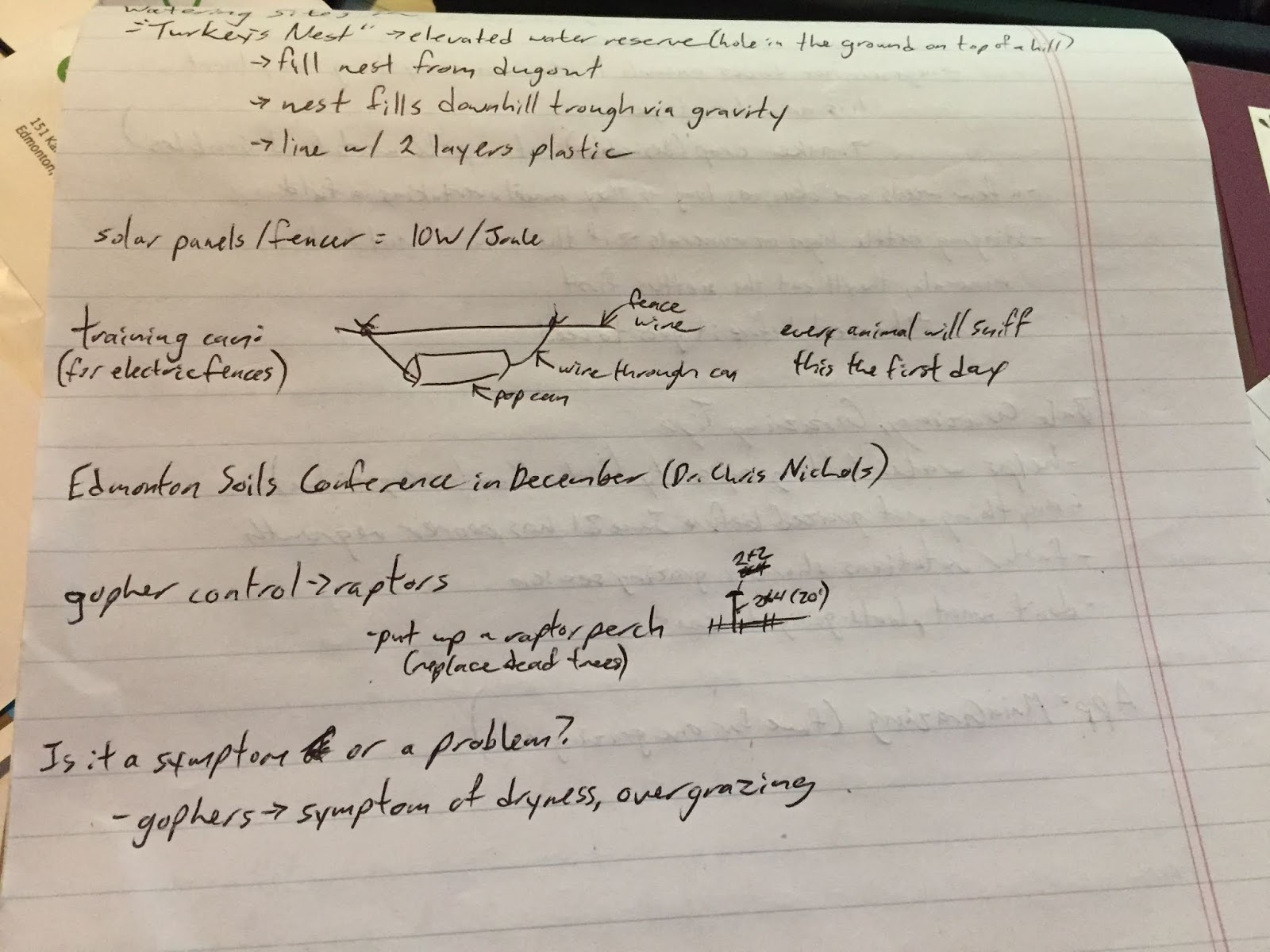
  • how to manage watering sites and riparian areas well
  • the ins and outs of direct marketing
  • winter fencing tips
  • electric fencing tips
  • pest control and how to know if pests are a problem or a symptom
  • the specifics of a University of Alberta study on carbon capture

One of six pages of notes I took at the pasture walk.  No one else took notes, but I retain information better that way.

There were about 20 of us in the pastures, all farmers seeking to increase our knowledge and to learn from a local farmer who has been trying things for years that we are all just a little nervous to try.  Within the pastures, we walked from site to site (hence, pasture walk).  However, to get from pasture to pasture, we were transported on a goose neck trailer, which had sturdy picnic tables strapped securely to it.  Illegal?  Most likely.  Unsafe?  Almost certainly.  The most exhilarating way to travel?  Absolutely!

The pasture walk took several hours, including a lunch break.  When it was over, we all just hung around, visiting and continuing to learn from each other.  As one of the youngest participants, I didn't say much, but I enjoyed listening to the conversations around me, most of which centered on the practical side of regenerative grazing techniques, something I've been acquiring an interest in.

If you are a farmer and a local county or research organization is putting on a pasture walk, I highly recommend attending.  If you aren't a farmer, I still recommend attending.  These types of events are where you will find farmers who are looking for a different ways to farm and take care of the environment.  These are farmers who are willing to seek out and try new techniques.  They are curious, thoughtful, innovative, and fun to be around.  

This was my first ever pasture walk and I had an amazing time!  Will you be checking out the next one in your area?

A Mixed Farmer's Response to an Appalling Anti-Vegan Post

Not long ago, I read a social media post.  It was distasteful, but I didn't pay it much mind.  A couple of days ago, however, one of my social media friends re-posted it and tagged me in the post.  Of course, I got blamed for the atrocious content of the post, which upset others of my friends, so now I must take the time to write a response.  Here it is.

The Offending Post

The post is unfortunate for a number of reasons, which I will outline here.

1. All vegans are attacked, when only a few need to be addressed.

While I am not against veganism itself, I do not generally appreciate the harsh criticism of animal activists who claim that animal agriculture is ruining the planet, our health, and everything else and promote a vegan lifestyle as a safer, healthier, environmentally friendly alternative.  I believe the above social media post is meant to address the arguments of such activists, but instead it unduly attacks all those who choose to be vegans.  I absolutely cannot condone any post that paints a large group of people in an unsavory light, as this one does.

2. Crop farmers are attacked.

Since when is it appropriate to show support for one portion of agriculture by attacking another?  Are we seriously trying to defend livestock farmers by saying, "Oh yeah, well those crop farmers are so much worse!"  Or, to quote the post, "Farmers routinely unleash an arsenal of agricultural weaponry upon unquestionably sentient 'pests'...come harvest time, combines and harvesters unavoidably shred millions of self-aware critters."  Really?  Why are we demonizing our neighbours?  And if I want to use this argument, I am demonizing myself as a crop farmer to justify myself as a beef farmer.  How ridiculous!

Besides, the harvest of crops does not always necessitate the shredding of critters.  For example, straight cut headers and stripper headers allow grains to be harvested in a manner which leaves the stalks still standing in the fields.  The critters that run about on the ground are therefore left intact.

3. Livestock farmers are made to look bad.

I have often found that those who are least deserving of respect are those who refuse to show respect.  This post gives the impression of being written from a livestock farmer's point of view.  How does such a disrespectful post make livestock farmers look any better?  It makes us look childish, petulant, and hard-hearted.  That won't help our image.

4. The arguments are unhelpful and easy to destroy.

To prove this point, allow me to give an example of a conversation that might occur.

Animal Activist (A1): Animal agriculture is cruel.  We should rid the world of animal agriculture and all go vegan!
Anti-Vegan Activist (A2): Harvesting crops also  kills animals!  You're horrible people, too!
A1: We don't purposely kill them like you do, so there!
A2: Well you kill more!
A1: Are you sure?  I picked [X vegetable] with my own hands and I bought [Y vegetable] from my friend at the farmer's market who hand picks everything, and my bread is made with wheat that I watched being harvested with a straight cut header, which was lifted high enough to avoid picking up rodents!  What have you to say to that?!

It's like watching two children argue, but the point is that I just destroyed the main damning argument of the entire post in 5 lines.  How on earth does that help anything?

This absurd post obstructs constructive conversation, fails to mount any defensible argument, and does nothing to acknowledge and improve on any of the shortcomings that actually do need to be addressed by the livestock industries.

Saturday, April 13, 2019

A Conventional Farmer's View of Organic Farming

It occurred to me recently that many of my readers might think I have an ax to grind against the organic sector.  And why not?  I've never given you any reason to believe that I feel anything other than disgust towards everything organic.  However, the reality is that I am extremely grateful that we have organic farmers.  Today, I want to clarify my stance towards the organic sector of agriculture.

I love to hear about the production methods used by organic farmers!  Dedicated readers (and Facebook followers) will have heard me talk about the farmer's toolbox before.  Farmers need to have a multitude of tools on hand to deal with the various challenges we face.  We need to have ways to deal with sick animals, pest problems, poor soil fertility and a host of other challenges.  Depending on the challenge, our tools to solve the problem generally fall into one of the following categories: chemical, mechanical, preventative, biological, or cultural.

To very quickly explain that, let's say that a farmer has a problem with some aggressive weeds in one of his fields.  He could control the weeds using chemical pesticides.  Or, he could till the soil, thus uprooting the plants, which is an example of mechanical control.  He might also prevent the problem in the first place by buying crop seed with a guaranteed minimum number of weed seeds in it (no crop seed is 100% clean).  He could use a biological method of control by finding and introducing a natural predator or pest to the plant.  Finally, the farmer might use cultural control by understanding how the weed plant grows and timing cropping activities to disrupt the weed's growth (for example, he might plant a perennial crop in a field plagued by annual weeds).  Each of these methods of controlling the weeds is a tool in the farmer's toolbox.

Organic farmers face the same challenges, but have fewer tools in their toolbox, mainly because they cannot rely on chemical controls to the same degree that conventional farmers can.  In recent decades, conventional farmers have relied heavily on chemical solutions to our problems, and because of that, we've been able to develop some really great tools in that category.  Unfortunately, we have, at times, relied on these tools too heavily, and that has caused us problems, as well.  Additionally, our strong dependence on synthetic chemicals means that we have forgotten how to use some of our other tools to the greatest effect.  That's where organic production comes in to save the day!

Organic producers have been searching for non-chemical solutions to our common challenges for just as many decades as conventional farmers have been working on chemical controls.  Because of that, organic producers are sometimes miles ahead of the rest of us in their effective use of such tools as biological controls and polyculture cropping systems.

Having grown up on a conventional farm, I barely know enough to even continue typing right now, but I've been slowly learning a little about these non-chemical solutions to common problems, and I am downright intrigued.  I have gotten a little bit nerdy in recent months thinking about how to incorporate such tools as biological agents, intensive grazing, and cover crops into my own farm.  It's mind boggling to think of all of the things I don't yet know!

Now, I'm not about to become an organic farmer, mind you.  I think that many of the synthetic tools we've been using have an important role in providing solutions, so long as they are not the only tool used.  However, I've been thinking that it's high time we moved just a few steps back from our synthetic chemicals and took a closer look at what the organic producers are doing.  Why not incorporate some more of those mechanical, biological, cultural, and preventative controls back into our farms, so that our approach to building solutions is more balanced than what is has been?

Why not put resources into research for polyculture crops, whether that means growing two cash crops simultaneously in a field, or planting one cash crop with cover crops that can be used for fall grazing, or any number of different scenarios?  Maybe if we could do this successfully, we could cut down on pest and disease pressure in our crops.  Maybe we could grow more on less land and then have some left over for livestock to graze after harvest!  And all without synthetic fertilizer or pesticides.

Why not put more resources towards finding biological agents to control pests.  We've got thistle stem-gall flies and stem-mining weevils to control Canada Thistle.  I recently read about beetles that eat weed seeds, such as volunteer canola.  And people have know for ages about the benefits of having ladybugs around!  Why not figure out how to cultivate these beneficial organisms?  Think of the totally cool science jobs that would become available if we put more resources into this type of research.  (Yes, there are totally cool science jobs in making chemical tools, too, but why can't we have more of both?)
A Canada Thistle Stem-Gall Fly. 
I bought some of these in 2018 to control some patches of Canada Thistle in my pasture.  Unfortunately, the thistles had been largely knocked out by a severe hailstorm the year before, so I found very few thistles on which to place my flies. 
And while we're at it, why not look a little more closely at some of the weirder things organic farmers have been doing?  Have you heard about using diatomaceous earth to control lice or adding garlic to cattle minerals to repel flies?  Why not see if that really works?  I think it would be easier to sprinkle a bit of powdery stuff on the back of the cattle than to have to squeeze that stiff applicator gun a hundred times to get the liquid insecticides on the cattle.  And feeding mineral with garlic in it really doesn't increase the cost much (yes, I definitely tried that last summer, but we kind of missed the heavy fly season window with it, so I can't actually say how well it worked).

And what about using livestock for weed control!  And I'm not just talking about training the animals to eat the weeds.  I'm talking about mob grazing and using strategy to get the herd to absolutely decimate that patch of weeds in a short amount of time, taking a field full of weeds and turning it into beautiful pasture in just a few years just by grazing it properly! 

Why aren't we conventional farmers doing these things that really work?!  Why aren't we looking for even more things that could work?!  The organic guys have such a huge head start in these areas and we're barely even paying attention to the amazing tools they've discovered!

By now you must be asking, "well then, if you're so excited about some of the options and advancements that have come out of the organic sector, why do you so often write against organic?"  I'm glad you asked.  My problem with the organic sector has next to nothing to do with the production of organic food and everything to do with how that food is marketed.

Organic has, for many years, been marketed as the only truly safe food in town.  It is supposed to be more nutritious and cleaner than its conventionally farmed counterparts, as well as being pesticide-, hormone-, GMO-, steroid-, antibiotic-,  whatever-else-"free." 

Oh, the lies that have been told!

I won't argue against specifics, as you can check out my past blog posts and videos to learn more about why you don't need to worry about GMO food, the use of artificial hormones (including steroids), the use of antibiotics, or the use of pesticides.  All I'm going to say is that, while being restricted in what can be used, organic farmers can use some of the tools that conventional farmers use.  For example, if an animal gets sick, an organic farmer can treat that animal with antibiotics, and still have the food that comes from that animal be certified organic.  There's just longer withdrawal times.  Also, organic farmers can and do use chemical pesticides.  These pesticides are ones that are derived from natural sources, rather than synthetic ones, but that does not mean they are any less toxic.

Knowing all of this, I can't help but become incredibly frustrated by the marketing tactics of companies selling organic food when they try to demonize conventionally grown crops, which I know to be safe for consumption.  And that is why I write so vehemently in defense of safe conventional methods and against organic marketing, even though I immensely enjoy hearing about the latest organic production methods.

Thursday, April 11, 2019

My Response to the Dirty Dozen

I had an interesting encounter on social media today. As always, I was relaxing for a while during my lunch break between my town job and my farm work and as I often do, I was casually scrolling through Facebook. A post from a radio station I follow suddenly caught my eye, and I stared at the post in disbelief. The post shared 2019's Dirty Dozen list and the recipe for a produce wash. After taking a moment to calm myself, I clicked into the comments and left my response, as you can see in the picture below.
This next picture is the reply I received.
Overall, a fairly civil conversation. Unfortunately, I'm not sure the station host quite understood why I have a problem with her sharing this misinformation with all of the station's followers.

In case you don't know, every year the Environmental Working Group (EWG) puts out the "Dirty Dozen" list, along with a "Clean Fifteen" list. These list the twelve fruits and vegetables with the highest levels of pesticide residue, and the fifteen fruits and veggies with the lowest levels, according to research done by the EWG. The EWG encourages people to buy the organic versions of the Dirty Dozen. Actually, they encourage people to buy the organic version of all produce. They do recognize, however, that organic produce is expensive, so for those who are afraid to buy any produce now, they recommend buying organic versions of the "dirtiest" fruits and veggies, while sticking to the "cleanest" ones if you must buy conventionally raised produce.

I have so many issues with the EWG and it's Dirty Dozen/Clean Fifteen Lists, but I'll try to stick to just the ones that really get me seething mad. This is not just a rant, mind you. I'm writing this blog post for a purpose; I want you, my readers, to know what this list is really about and why you don't need to shop in fear.

Issue 1: The Information is Misleading and the Science is Shoddy.
Evidence that the EWG's scientific findings are suspect
Issue 2: The EWG is funded mainly by organic groups and businesses. This creates bias.
Funding information straight from the EWG's "About Us" section of their website

Issue 3: The misleading information is having real and negative effects on buying habits.
A Screenshot from the EWG's Dirty Dozen FAQ Page

A scholarly article on the detrimental effect that lists such as the "Dirty Dozen" have on the diets of low-income consumers

Issue 4: The lists ignore Organic Pesticides. Again, this shows bias.
A few of the approved organic pesticides that producers can and do use

Want to know more? Ask a farmer - both organic and conventional farmers should be able to tell you why lists like the "Dirty Dozen" hurt us all. We don't need fear to sell our food.